Showing posts with label movie. Show all posts

Monday, June 17, 2013

A Man of Steel meta-review/review

I'm frustrated. Frustrated at movie reviews written by reviewers who either hate action movies, or didn't even bother to watch Man of Steel. Frustrated at reviews that have barely mentioned actual problems with the film (opting to point out perceived issues available to anybody who's seen the trailer), and ignoring some of the magnificence of this film.


Superman, as a character, is both delightfully complex and wonderfully simple. He's an amalgam of the original Siegal and Shuster car lifting creation, expanded through the cold war as an unstoppable living symbol of benevolent omipotent American nuclear power, diminished and capped in the late '80s, revisited as a modern Greco-Roman god in Ross and Waid's beautiful Kingdom Come, been the subject of both a romantic drama and a romantic teen drama. The Superman we come to in Man of Steel must be viewed through this lens.

The Goyer, Snyder, Nolan Superman is a good-hearted Kansas boy with a complex and difficult childhood, struggling to understand his differences and his growing powers, given strength and focus by adopted parents trying their best to keep their son safe, show him right from wrong, but give him the agency of choice. He's a young man struggling with identity, hidden and overt, and with the gift and burden of the choice the Kents endowed him with. He's a complex hero, drawn towards good, but frustrated with his hidden identity and the shackles it puts on him to stop wrong in the world. He's Hercules struggling through god-sized labors.

This character is beautifully revealed through a series of easy-to-follow flashbacks and connections to the Clark of the present, bedded on one of the best scores I've heard in a generation. It's a natural evolution of Zimmer's Inception musical language, given subtlety through constant plays on a few lietmotifs, the theme of right and the theme of wrong -- so well structured that the same motif is used in a quiet inspiring single-note piano theme hinting at the coming of power, then seamlessly expanded into triumphant horn blasts, electric guitars and intense percussion to shake the firmament. The expanded soundtrack also includes a stunningly beautiful half-hour sketch that shows some different directions the score could have taken. I have a feeling that this is a soundtrack that will reward repeated listens over the next few months.

Like music, the film is structured to start slow, visiting Krypton and giving motivation for the antagonists. Then visiting with the different Kal-Els as he comes to terms with the different stages of his life -- the one we know will result in the hero Superman, but beautifully told. How young Clark, in the end, couldn't choose but had to follow the path of good. This is all revealed in a series of non-linear pieces from different time periods of Clark's life, slowly opening like petals, each offering a piece of the whole. From there it crescendos into the kind of epic battle of the gods that Superman deserves to have put down on film. A man that can throw a train without breaking a sweat has the power to destroy a city block, an enemy space ship, a bank vault and more. We see the what super powered beings of this nature could really do if let loose in the middle of a populated city.


The action is fast, and huge, but unlike recent Michael Bay movies, is coherent and easy to follow. Super-powered mega punches are followed with Newtonian ballistic trajectories, military equipment moves in a way that makes sense, and when it doesn't make sense it still makes sense.

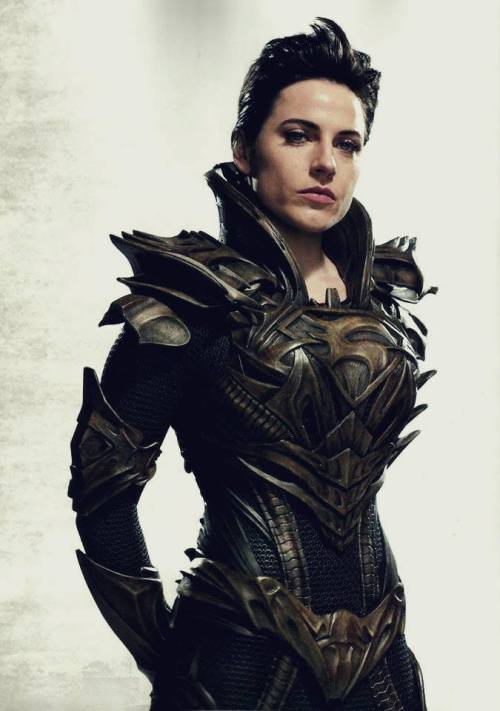
The bad guys, bred and trained warrior Kryptonians, Zod (Michael Shannon) and Faora-Ul (Antje Traue) and some cronies are magnificently played. Traue in particular exudes a kind of exotic icy cold ruthlessness that's damn near terrifying next to Shannon's more expected rage filled heat. Faora-Ul is the cold winter that freezes you to death while Zod is the hot fire that will burn you alive. Major supporting cast are credible, decent, warm people. Costner's earnest Kent was easily the actor's best performance in years, and beautifully played. Adams' charming Lane is the reporter you want to know better. Diane Lane plays a doting mother, Russell Crowe a powerful and conscientious Jor-El figure, Harry Lennix a very serious General Swanwick, Christopher Meloni's honorable Colonel Hardy and on and on. Great performances from even minor characters.


And then Cavill performs what will be the new template for the character. He derives and owns the part, finally breaking it away from the Reeves portrayal. He's a dash of the Kingdom Come Superman, but freed of the late 80's power caps. He struggles with his labors, but doesn't know his limits. There's no tossing of islands full of Kryptonite into space. We're literally finding out what Superman can do as he does. His Clark is relatable, with a light humor, a trustworthy guy you want to know, but with hidden struggles.

And then it's over, and the film decrescendos, strings are tied off, sequels are set up and we end introduced to Clark Kent post crucible. His identity struggles sorted out as he's decided to embrace both Clark and Kal-El, but as two sides to one man, pulling in the same direction instead of in conflict.


It's not perfect, there are issues, minor quibbles really: the macguffin that drives Zod and his cronies to Earth is almost as dumb as midichlorians (even if it does give Zod a raison d'ĂȘtre), the fall of the Kryptonian civilization after the destruction doesn't make any kind of sense upon close inspection, the Kryptonian's new weakness (gone is Kryptonite as a plot device) is weak, Jor-El as a mainframe virus is inconsistent, Zod's pirate TV station broadcast is mostly unnecessary, some of the plot is told through ham fisted dialog, Jor-El is a surprisingly kick-ass scientist, there's some significant rewriting of Superman canon...aaaand....that's about it.

So why am I frustrated? Let's try an experiment:

  1. Watch all of the Man of Steel trailers
  2. Go to Rotten Tomatoes and click a random review
  3. Read the review, is there anything reviewed that doesn't come from the trailers?
If so does it follow on the following complaints?:


  • There's too much action...in an action film.
  • There's not enough Romance between Clark and Lane.
  • The story uses flashbacks and apparently reviewers are confused about this technique having never seen it in a story ever in their lives.
  • Superman wasn't funny. Seriously.
  • Clark Kent wasn't a bumbling fool, a characterization which only exists in the 80's movies.
  • Clark isn't a complex character.
  • Endless whining about it being too long.

Some of the reviews are factually incorrect: I've seen reviews that mix up Jor-El and Kal-El, claim the Clarks come from Texas, that Zod destroyed Krypton and on and on.

At this point I'm pretty sure that almost none of the reviewers have actually watched the film. The days of well written, well considered reviews a la Ebert really are gone.

Some examples:

  • Here's a review by the Atlantic's Christopher Orr that literally doesn't make any sense. For reference here's his gushing review of Superman Returns. I mean really, which is the better movie? Orr vs. Orr comes down firmly on the 2006 movie's side, which as any person who actually likes movies would find abhorrent.
  • How about Newsday's Rafer Guzman? "...this reboot skimps on fun and romance..." and "Krypton is needlessly refashioned into Middle Earth, with dragons and wizards" I don't think I need to say anything else. Guzman really just wanted to see a 90 minute Lois & Clark movie.
  • Kaplan vs. Kaplan: A review written by people who really honestly just hate seeing action on screen and pine for longer romance and family relationship scenes (which decidedly don't involve Superman doing super things) and can't sit still for an entire 2 and a half hour movie and can't get over why there's no Lex Luthor in this movie.

Disgraceful

For reference: Rotten Tomatoes viewer rating is over 80% and IMDB viewer rating is at over 8 out of 10.

Here's a discussion I think is well considered, reasonable panel review, with dissenting opinions I can even understand and get behind.

I can't wait for the sequel.

Tuesday, December 28, 2010

Tron : Legacy - Analyzed as a Religious Allegory


The technology, open source bits and corporate back-story is a red herring nobody seems to be able to see past. Watching it I couldn't help but notice it's chock full of religious commentary (mostly Christian but sprinkled with some Buddhist and miscellaneous other Eastern philosophies). I’m not religious by any stretch, but I found the movie deeply satisfying when viewed this way.

***Warning Spoilers***
This analysis is very preliminary, I’ve only seen the movie once, but I think it’s fairly sound.


  • In the movie Kevin Flynn represents the Christian God the Father, the creator of all things, all powerful, all knowing (supposedly) etc. etc.
  • Tron represents the Christian Holy Spirit, the kinetic 'action' arm of God (or perhaps more likely an Archangel like Michael or some synthesis).
  • CLU then, I thought originally, represented Jesus, but may also represent the Christian God's other creation, Lucifer (or perhaps both simultaneously).
  • (I'll get to Sam Flynn in a minute).

Where the story plays with the allegory (and quite cleverly I think) is in the twist it takes on the traditional Judeo-Christian story of God the father, omniscient and omnipotent. In the story Flynn sets out to create a new world with his holy trinity, and while he thinks he's creating something fantastic, all he ends up doing is creating conditions ripe for a new life-form that, emerge from the wilderness. This is commentary that perhaps mankind was not the direct creation of God, but an emergent behavior of a complex universe that God couldn't possibly understand.

From there, it uses this principle to define the rest of the story.

CLU, tasked with creating perfection turns against his master to eradicate this new life-form and leave Flynn a powerless and mere observer of the going ons in his creation. With the power of destruction and the ability to repurpose programs, CLU tries to build an army of true believers to take into the real world and conquer it. Considering the Christian Story of the apocalypse, the story is not about world domination in the 007 sense, it's about Satan's gathering of an army, turned by temptation and corruption (which has meaning in both the digital and religious worlds), into an assault on Heaven itself! Here Heaven is the real world (as represented by the portal high in the clouds). Except in Tron, Heaven is deeply flawed and not the world of perfection described in Christianity.

The allegory extends further if you consider the common concept in many Christian faiths that God must leave the world alone for mankind to exercise free-will. The story hints at this, that the programs have a kind of free-will, there are programs that resist CLU and ones that seek to serve him. Even the turned army is given an inspirational speech to keep them along CLUs path...implying that they need encouragement to stay on his side.

Where the commentary gets some spice is in the elements of Buddhism and Eastern philosophies that are brought in. Left as an observer, Flynn fights the compelling need to interfere in his world by seeking a Buddhist-type detachment. It finds him deep in meditation, a Guru to Quorra (who represents a particular naive and warlike humanity in the movie BTW)...on the edge of Enlightenment -- advising non-action. To further add to this, he's meditating high in a mountain, far from "civilization" in his quest for detached enlightenment, just as Buddhists today will head to the mountains to meditate and focus on their detachment. His house is a representation of the things he has not yet detached from...most things are pale imitations of things in the real world, the furniture is white and featureless, but implies a rich elegance (temptation towards attachment), but the furnishings are rather spartan in a way. Yet two notable things are virtually exact mimics of things that Flynn cannot yet give up (representing how far he has to go to yet achieve enlightenment), food (sustenance) and books (knowledge). These things are rendered in exacting detail, down to dusty book covers. And the books in particular standout as center pieces in his home. The sudden appearance of Sam convinces Flynn that enlightenment, detachment from the world and inaction, are not the right ways to go, and he resumes his place as God the Father to save his son from creation out of his control and under the influence of Lucifer/CLU (in notable opposition to the Christian tradition of God the Father sacrificing his son) and send him (and humanity as Quorra) back to heaven.

However, this changes back as Flynn finds further and further detachment from the world useful. In order, he abandons his house (and thus the last remnants of the real world, his books and food). Then he abandons the world and Sam in a final act where he faces and absorbs his last vestige of attachment, his ego/CLU and brings about not only the end of the world but also enlightenment.

Sam Flynn represents a kind of Jesus/Adam character in opposition to Flynn's false son Lucifer/Jesus/CLU. It's an interesting literary fracturing/blending/bending of Jesus/Lucifer/Adam as a character into two parts. CLU, who is to do Flynn/God's work on Earth/the Grid for him, just as Jesus was to perform God's work on Earth for God the Father. Sam represents simultaneously Flynn's true son, and the first man in the Grid (with Quorra the first woman). Another interesting twist on this concept is that the movie ends with Flynn sacrificing himself (as opposed to his son), by reintegrating with his false creation CLU with himself, thus bringing about the end-times and destroying the world/grid. This is of course a metaphor for both the Judeo-Christian story of Jesus's sacrifice (re-rendered as God the Father's sacrifice) and for the Apocalypse.

Quorra represents both humanity and Eve before temptation. As humanity she represents an uncontrollable free-will, and warfare. Notably, even though she appears a warrior in the movie, her skills never seem to quite match up with the tri-part God's abilities, thus ensuring her place in the hierarchy of the characters -- yet she's willing to sacrifice herself to/for her God. As a woman, she represents Eve, the first woman. And like in the Judeo-Christian tradition, it's never discussed or revealed where the rest of humanity comes from (others of her kind, the Isomorphs). As the bearer of children, women are also often symbols of humanity.

Other characters can be analyzed this way as well, Gem & Castor also represent humanity, but they represent temptation and false paths. Quorra, flawed as humans are, send's Sam to meet with Castor, obviously from younger years when she was tempted and entranced with this character. As a nightclub owner and sometimes revolutionary, he represents the temptation of cheap thrills and a wayward path that would ultimately lead to Sam's (and the real-world/heaven's) destruction. Only the appearance of God-the-Father/Flynn sets Sam and Quorra back on the straight and narrow (interestingly represented by the Solar Sailor, which rides a straight and narrow beam of pure light and in the interest of extending interesting dichotomies via twists in traditional Judeo-Christian stories is also the vehicle Satan/CLU is using to bring his armies to Earth/the flawed Heaven).

There are more analogies and symbols that bring it home, the Grid is obviously an extrusion of solid land in an ocean. The floating stones leading to heaven represent a kind of stairway or ladder to heaven. In an extension of more traditional symbolism, discs are the place of the soul, but are also a traditional symbol of heaven in the Chinese tradition. The grid evokes the idea of squares which is the traditional Chinese symbol for Earth. In the beginning of the movie, Sam is seen falling from on high both literally via a parachute, and figuratively as he descends from the opulent Encom tower down to street level, then his warehouse/house then to an obviously crappy part of town, then into the arcade where he descends even further down stairs and finally behind a closed door until he descends down into the Grid (where he descends further in the Armory). Only after he descends, literally into hell, does the story really begin. This evocative both of the Christian story of Jesus's descent into hell before his ascent into Heaven, but also of the notion, present in some traditions, that only through suffering can one ascend into heaven/enlightenment -- present in both some forms of the Judeo Christian tradition and several Eastern philosophies.

As commentary, it rejects the notion of an involved, omniscient, omnipotent God. Instead it makes the bold statement that God is aloof, uncaring and in the end only destructive of his creations -- Flynn's major contribution when he gets involved is to bring about the apocalypse in the grid. God/Flynn sits bewildered and amazed at emergent behaviors in a complex system, at the craftiness of his own creation (CLU's coup), Sam's presence in the Grid, Quorra's impulsive behavior, etc. He is powerless to effect change in a creation grown greater and stronger than he. His own creation, the Grid evokes the world and hell at once. While the real world/Heaven is represented as free from Satan/CLU's control. And perfect in its flaws, as opposed to a fake perfection. CLU as Lucifer also represents ego, and the presumption that ego brings about great suffering. Flynn seeks detachment as a way of throwing away ego, paying for his mistakes...the flaws of an ego filled, jealous God made manifest in his own creation. Curiously, by reintegrating with his ego/CLU, Flynn not only brings about armageddon, but it's represented by a blinding light that may also symbolize finally achieving enlightenment as Flynn rejects the real world. His soul/disk is left in Sam's possession at the end, supposedly as a prophet to bring this news out into the world forgetting that it brought about the end of the world.

I actually found the movie's symbolism and commentary very deep and I'm only touching the surface here. I'm sure on further viewings I'll find more. The plot as such is merely a scaffolding for this rather interesting blending of Judeo-Christian and Eastern philosophies. I think the only point I'm yet to resolve is the flip-flopping of Flynn from detachment to attachment back to detachment. Perhaps this is supposed to evoke Buddha's final walk on down the Middle Way?